
Income Tax Advisory Services for Salaried Individuals by CA in India
CA-led tax planning that keeps more of your salary in your pocket
Most salaried professionals in India quietly overpay tax every single year — not because they earn too much, but because no one ever showed them how to plan. They invest at the last minute, pick a tax regime without comparing it, miss deductions they were fully entitled to, and only think about tax in the few stressful weeks before the filing deadline. Income tax advisory services fix exactly this. Good Tax Planning For Salaried India means you plan ahead instead of reacting at year-end, and the right Tax Saving Tips Individuals India can use only work when they are matched to your own salary, regime and goals. At ITR Tax Advisor, our Chartered Accountants help salaried individuals plan ahead, structure their finances smartly, and legally reduce their tax — so you keep more of what you earn, every year. Whether you are searching for a trustworthy income tax advisor for salaried employees or simply want to know how to save tax on your salary, this page is written for you.
With 25+ years of taxation experience and a team of qualified CAs, we have guided thousands of salaried professionals across India — from first-jobbers to senior executives, from single-salary earners to those juggling salary, rent, capital gains, and side income. This page explains what tax advisory really involves, how proactive tax planning works for salaried individuals, the tax-saving strategies that actually move the needle, and why expert guidance pays for itself many times over. You will also find a side-by-side old versus new regime comparison for FY 2026-27, a checklist of common mistakes, and clear answers to the questions salaried taxpayers ask us most.
Stop overpaying tax. Start planning.
Call 9406800066 • WhatsApp our CA team • Get a free quote at itrtaxadvisor.com/contact-us
Book a free consultation and find out how much you could legally save.
What Are Income Tax Advisory Services?
Income tax advisory services are the proactive, year-round guidance a qualified professional provides to help you manage and minimise your tax liability legally. It is fundamentally different from simply filing your return at year-end. Filing looks backward — it reports what already happened. Advisory looks forward — it shapes your decisions during the year so that, when filing time comes, your tax is already as low as the law allows.
Think of it this way: filing is recording the score; advisory is helping you win the game before the final whistle. A good tax advisor reviews your income, your investments, your goals, and your salary structure, then builds a plan that uses every legitimate deduction, exemption, and regime choice available to you.
For salaried individuals, income tax advisory services typically cover regime selection (old versus new), deduction planning, salary-component optimisation, investment-linked tax saving, capital-gains planning on shares or property, and making sure your TDS is neither too high (locking up your cash) nor too low (creating a year-end shock).
Good advice also means staying current. The Income-tax Act, 2025 came into force on 1 April 2026 and renumbers the familiar sections, while the slab structure announced earlier continues for FY 2026-27. A CA-led advisory team tracks these changes for you, so your plan is built on the rules that apply to your year — not on last year’s rules or a forwarded WhatsApp tip. For readability we refer to sections by the numbers taxpayers know best (80C, 80D, 87A); our CA applies the correct provisions for your year.
Why Salaried Individuals Need a Tax Advisor
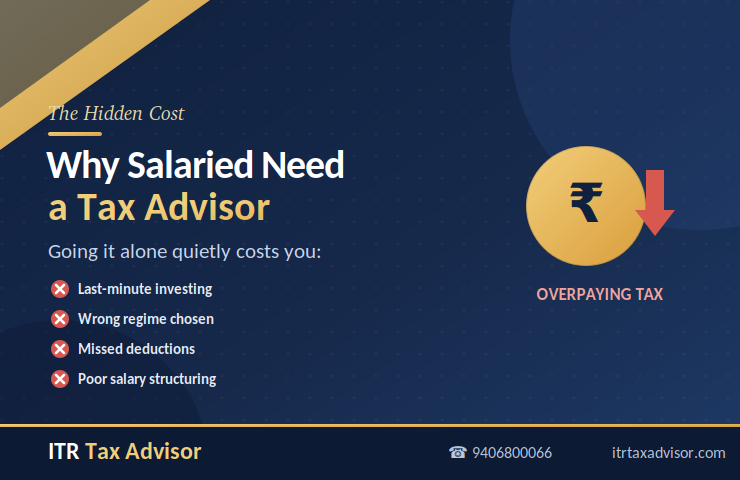
The hidden cost of doing it alone
There is a common myth that salaried taxpayers have “simple” taxes and do not need help. In reality, salaried individuals are among the most likely to overpay, precisely because they assume it is straightforward. This is why more working professionals now look for income tax advisory services before the financial year starts rather than after it ends. Here is where it goes wrong without guidance:
- Last-minute investing — scrambling in March to save tax leads to poor, locked-in products bought for the wrong reasons.
- Wrong regime choice — with the new regime now the default and income up to ₹12 lakh effectively tax-free after rebate, many people assume it always wins; for those with large HRA, home loan and 80C claims, the old regime can still cost less. Picking either one without comparing the numbers for your situation can cost you thousands.
- Missed deductions — HRA, NPS, home loan interest, health insurance, and more are routinely under-claimed.
- Poor salary structuring — not using available components and reimbursements that could lower taxable income.
- Ignoring other income — interest, dividends, capital gains, and freelance income mishandled, leading to notices.
- No forward planning — treating tax as a once-a-year event instead of a year-round strategy.
A tax advisor turns all of this from guesswork into a plan. The fee is almost always a fraction of what you save — which is why the smartest salaried earners treat advisory as an investment, not a cost.
Curious how much you’re leaving on the table?
Share your salary structure on WhatsApp — our CA will spot savings opportunities.
Call 9406800066 or request a free quote at itrtaxadvisor.com/contact-us
Tax Planning for Salaried Individuals in India
Plan early, save more, stress less
Effective Tax Planning For Salaried India is about making deliberate choices early in the financial year rather than reacting at the end. Because your employer deducts TDS based on the regime and investment declarations you submit at the start of the year, the first few weeks are your most valuable planning window. Our CAs build a personalised plan around four key levers:
Choosing the right tax regime
The old regime rewards you for claiming deductions and exemptions; the new regime offers lower slab rates but withdraws most of them. The right choice depends entirely on your income and how much you invest or claim. We calculate your liability under both for the current year and recommend the one that costs you less — a decision worth thousands that too many people guess at. For FY 2026-27 the new regime is the default: income up to ₹12 lakh is effectively tax-free after the Section 87A rebate, which works out to about ₹12.75 lakh for a salaried person after the ₹75,000 standard deduction. Above that level, or where you have large HRA, home loan and 80C claims, the comparison needs actual numbers. Salaried taxpayers with no business income can generally choose between the two regimes each year, so this decision deserves a fresh look annually.
Structuring your salary smartly
Two people on the same gross salary can pay very different tax depending on how their package is structured. Where your employer allows flexibility, components and reimbursements can be arranged to make the most of available exemptions, reducing your taxable income legitimately. Common levers include employer NPS contribution, the HRA component for those who pay rent, and eligible reimbursements allowed by your company’s policy — though which of these help depends on the regime you choose.
Planning investments with purpose
Tax-saving investments should serve your real financial goals — retirement, a home, your children’s education — not just a March deadline. We align your tax-saving choices with your goals so every rupee works twice: once to save tax, once to build your future. If you stay in the old regime, a disciplined monthly SIP into an ELSS fund, PPF or NPS can serve both goals at once. Where you want a structured long-term plan, our Sip Investment Advisor India team can build it alongside your tax plan.
Managing TDS and advance tax
We help ensure the right amount of tax is deducted through the year, so you neither hand the government an interest-free loan via excess TDS nor face a nasty shortfall at filing time. If your tax payable after TDS is ₹10,000 or more in a year — common when you have rent, interest or capital gains on top of salary — advance tax instalments apply, and missing them attracts interest.
Smart Tax-Saving Tips for Individuals in India
These Tax Saving Tips Individuals India can use are proven, legal levers our advisors help salaried clients use to the fullest. The exact limits are set by the government and revised periodically, so we always apply the current figures for your assessment year. Most of the deductions below apply only under the old regime (the standard deduction and employer NPS contribution work in both), so read them together with the regime comparison that follows:
- Section 80C — investments and expenses like EPF, PPF, ELSS, life insurance, and principal repayment on a home loan, up to the prescribed limit (₹1.5 lakh a year under the old regime).
- Section 80D — premiums for health insurance for yourself, family, and parents. Limits are higher for senior citizens, and our Insurance Advisor In India team can help you choose adequate cover, not just a tax-saving policy.
- NPS — Section 80CCD(1B) — an additional deduction for National Pension System contributions, over and above 80C (up to ₹50,000). Employer NPS contribution under Section 80CCD(2) is allowed in the new regime as well.
- HRA exemption — if you live in rented accommodation and receive House Rent Allowance, a significant exemption may be available under the old regime.
- Home loan interest — Section 24(b) — deduction on interest paid on a housing loan for a self-occupied or let-out property (up to ₹2 lakh for a self-occupied property under the old regime).
- Standard deduction — a flat deduction available to salaried individuals against salary income: ₹50,000 in the old regime and ₹75,000 in the new regime.
- Leave Travel Allowance (LTA) — exemption on travel costs, subject to conditions.
- Section 87A rebate — a rebate that can reduce or eliminate tax for those within the eligible income limit. Under the new regime it makes taxable income up to ₹12 lakh tax-free; under the old regime it applies up to ₹5 lakh. It does not cover every kind of income — certain capital gains taxed at special rates are excluded.
- Capital gains planning — timing and structuring sales of shares, mutual funds, or property to manage gains tax efficiently.
The art lies in combining these correctly for your specific income, regime, and goals — which is exactly what a CA advisor does. Generic tips help; a tailored plan transforms your tax bill. That is the difference between a list of generic Tax Saving Tips Individuals India find online and a plan that is actually yours — and it is how Tax Planning For Salaried India turns separate tips into one coherent strategy.
Want these strategies applied to your exact situation?
Get a personalised tax-saving plan from a CA — built around your salary and goals.
Call 9406800066 • WhatsApp us • itrtaxadvisor.com/contact-us
Old vs New Tax Regime: A Quick Comparison
One of the most consequential decisions for a salaried taxpayer is the regime choice. Here is the essential difference our advisors help you weigh for FY 2026-27 (figures as currently in force; we confirm them for your year):
| Aspect | Old Regime | New Regime |
| Slab rates | Higher base rates (basic exemption of ₹2.5 lakh) | Lower base rates (nil tax up to ₹4 lakh) |
| Deductions (80C, 80D, HRA, etc.) | Available | Mostly not available |
| Standard deduction | ₹50,000 | ₹75,000 |
| Section 87A rebate | Tax-free up to ₹5 lakh of taxable income | Tax-free up to ₹12 lakh of taxable income (about ₹12.75 lakh for salaried) |
| Best for | Those who invest / claim deductions | Those with few deductions |
| Decision | Worth it if deductions are high | Simpler, can be cheaper if not |
There is no one-size answer — the better regime changes with your income and deductions, and even year to year. We run your actual numbers both ways so the choice is based on fact, not assumption. Because the new regime is the default, your employer will assume it unless you opt otherwise — so submit your regime choice and investment declarations early in the year. Several of the Tax Saving Tips Individuals India rely on, such as 80C, 80D and HRA, are old-regime benefits, which is why effective Tax Planning For Salaried India starts with this comparison.
How Our Tax Advisory Service Works
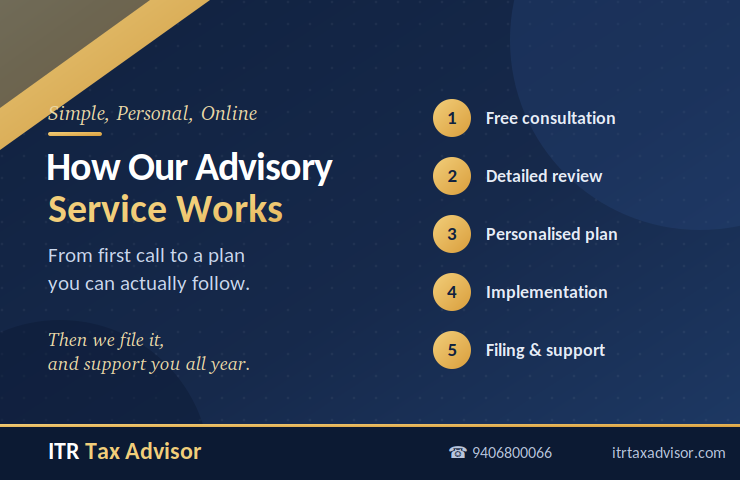
We have made expert tax guidance simple, personal, and fully online. Our income tax advisory services follow the same six steps for every salaried client. Here is what working with us looks like:
- Free consultation — call, WhatsApp, or submit the form. We understand your income, goals, and current tax situation.
- Detailed review — we analyse your salary structure, investments, other income, and last year’s return alongside Form 16, Form 26AS and AIS to find gaps and opportunities.
- Personalised plan — we recommend the optimal regime, deductions to target, investments aligned to your goals, and TDS adjustments — your written Tax Planning For Salaried India roadmap, including the Tax Saving Tips Individuals India can use this year.
- Implementation guidance — we tell you exactly what to do and when, through the year, so the plan actually happens.
- Filing and follow-through — when the year ends, your return reflects the plan, and we file it accurately for you.
- Year-round support — under our membership plan, your advisor is available whenever a financial decision has a tax angle.
Why a CA Advisor Beats a DIY App
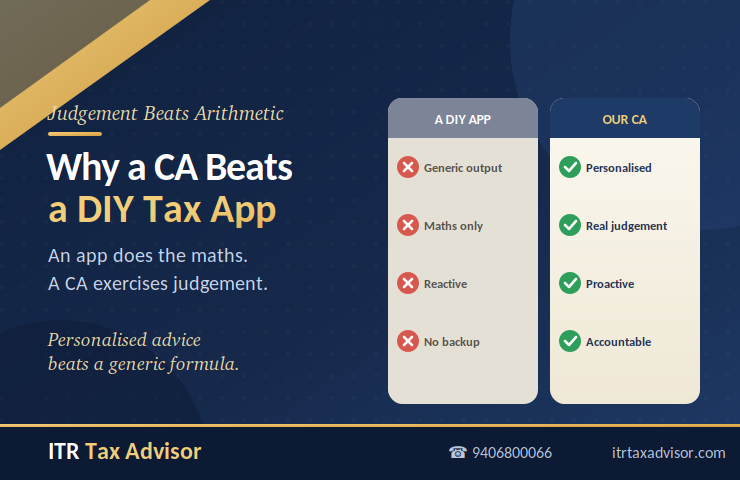
Tax apps and calculators are useful for arithmetic, but they cannot do what a Chartered Accountant does: understand your whole situation and exercise judgement. Good income tax advisory services combine software accuracy with a CA’s judgement. The difference matters:
- Personalised, not generic — advice built around your salary, goals, and family, not a one-size template; generic lists of Tax Saving Tips Individuals India read online rarely fit your numbers.
- Proactive, not reactive — we plan through the year, not just compute at the end, which is the essence of Tax Planning For Salaried India.
- Judgement on grey areas — regime choice, capital gains timing, and salary structuring need experience, not just a formula.
- Accountability — a qualified professional stands behind the advice and handles any questions or notices.
- Holistic view — we connect tax with your insurance, investments, and loans for a complete financial picture.
- Current-law awareness — with the Income-tax Act, 2025 now in force, section numbers and forms have changed; a CA keeps your plan and your return aligned with the provisions that apply to your year.
An app tells you what you owe. A CA advisor helps you owe less — legally, confidently, and with a plan you understand.
Ready for advice that’s actually personalised?
Call 9406800066 • WhatsApp our CA team • Email info@itrtaxadvisor.com
Get your free quote: itrtaxadvisor.com/contact-us
Who We Help
Our salaried tax advisory is tailored to a range of professional situations:
- First-time and early-career earners — set good habits early and never overpay from day one.
- Mid-career professionals — optimise across salary, home loan, family health cover, and growing investments.
- Senior executives and high earners — manage higher slabs, RSUs/ESOPs, and capital gains with careful planning.
- Salaried with side income — freelancers, landlords, and investors who need their multiple income streams handled correctly; and if your side income grows into a real business, our Tax Advisor For Business India team can take over from there.
- Salaried NRIs and returning professionals — if you earned in India while living abroad, our ITR Filing For NRI India service files your return correctly for your residential status.
- Anyone facing a notice or confusion — get clarity and a professional response.
Whatever your salary band, our income tax advisory services and Tax Planning For Salaried India approach are shaped around your situation, not a template.
Common Tax Mistakes Salaried Individuals Make
Year after year, we see capable, well-paid professionals make the same avoidable errors. Recognising them is the first step to keeping more of your money, and avoiding them matters as much as applying the Tax Saving Tips Individuals India already know:
- Investing only in March — rushing tax-saving investments at year-end usually means picking the wrong products for the wrong reasons, locking money into things that do not fit your goals.
- Choosing a regime by habit — sticking with old or new because a colleague did, instead of comparing the actual numbers for your own income.
- Assuming the new regime always wins — it often does at lower deduction levels, but with large HRA, home loan and 80C claims the old regime can be cheaper. Compare before you commit.
- Forgetting to declare investments to the employer — leading to excess TDS and an unnecessarily long wait for a refund.
- Ignoring Form 26AS and AIS — not reconciling what the tax department already knows about your income, which invites mismatches and notices.
- Overlooking small income heads — savings interest, fixed deposit interest, and dividends that quietly add to taxable income if not planned for. Freelance income on the side can also cross the GST threshold, in which case you may need GST Registration For Small Business.
- Treating tax as a one-week event — the single biggest mistake, because the best savings come from decisions made across the whole year.
Every one of these is preventable with a plan. That is precisely what advisory delivers — foresight instead of hindsight. Sound Tax Planning For Salaried India removes each of them, and strong income tax advisory services catch them before they cost you money.
What We Review in Your Tax Advisory Session
To build a plan that genuinely fits you, our CA looks at the full picture. In a typical advisory session we review:
- Your salary structure and Form 16, to find optimisation opportunities
- Your existing investments and insurance, and how they map to deductions
- Any other income — rent, interest, dividends, capital gains, or freelance earnings. Where your records are scattered, Monthly Bookkeeping Services India can keep them tidy through the year
- Your financial goals, so tax-saving choices also build your future
- Last year’s return, to catch missed deductions and recurring leaks
- Your current and projected TDS, to keep cash flow healthy
From this, we produce a clear, personalised action plan — what to do, how much, and when — so the savings are real and the path is simple to follow. You leave with a written roadmap listing the Tax Saving Tips Individuals India can use this year, not just a verbal opinion.
Why Choose ITR Tax Advisor
Experience you can verify, advice you can trust
Salaried professionals across India trust ITR Tax Advisor to plan smarter and pay less, legally. Here is why:
- 25+ years of taxation experience — through every major change in India’s tax law.
- Qualified Chartered Accountants — real expertise and judgement, not just software; your plan is prepared and reviewed by professionals who are accountable for it.
- Pan-India, fully online — get advised from anywhere in India, paperlessly.
- Holistic financial view — tax, insurance, investment, and loan guidance under one roof.
- Transparent, fixed-fee pricing — clear costs with no surprises.
- Honest scope — we explain your options and the tax impact of each; the final decisions and investments remain yours, and we never promise guaranteed refunds or “zero tax”.
- Trusted by 600+ reviewers — with a strong record among salaried clients.
Our goal is simple: make sure you never overpay tax again, and that every financial decision you make is a tax-smart one. That is what our Tax Planning For Salaried India approach is built for.
Plan your taxes with experts who’ve done it for 25+ years.
Call 9406800066 • WhatsApp our CA team • Email info@itrtaxadvisor.com
Free quote: itrtaxadvisor.com/contact-us • Ask about our membership plan for year-round advice.
Frequently Asked Questions
What are income tax advisory services?
Income tax advisory is proactive, year-round guidance from a qualified professional to help you legally minimise your tax. Unlike filing, which reports the past, advisory shapes your financial decisions through the year so your tax is as low as the law allows. For salaried individuals it covers regime choice, deductions, salary structuring, and investment-linked planning. At ITR Tax Advisor, these income tax advisory services are delivered online by Chartered Accountants across India.
Do salaried individuals really need a tax advisor?
Yes, more than most people assume. Salaried taxpayers frequently overpay by investing late, choosing the wrong regime, and missing deductions like HRA, NPS, and home loan interest. A tax advisor turns guesswork into a plan, and the fee is usually a fraction of what you save. If your income is only salary and you claim no deductions, a quick check may be enough; once you have HRA, a home loan, investments, capital gains or side income, professional Tax Planning For Salaried India usually pays for itself.
How can a salaried person save tax in India?
A salaried person can save tax by first choosing the right regime and then making full use of the deductions available under it — Section 80C, 80D, NPS under 80CCD(1B), HRA, home loan interest, the standard deduction and LTA under the old regime, and the standard deduction, employer NPS contribution and Section 87A rebate under the new regime. The key is combining them correctly for your situation, which is what our advisors do. These are the Tax Saving Tips Individuals India can rely on most.
What is the difference between tax planning and tax filing?
Tax filing is submitting your return at year-end, reporting income and tax already incurred. Tax planning happens through the year to reduce that tax in advance — choosing the right regime, timing investments, and structuring income. Planning lowers your bill; filing records it. That is why Tax Planning For Salaried India works best when it starts in April, not March.
Should I choose the old or new tax regime?
It depends on your income and how much you claim. The new regime is the default and makes taxable income up to ₹12 lakh tax-free after rebate (about ₹12.75 lakh for salaried individuals), so it often suits people with few deductions. The old regime can be cheaper if your HRA, home loan interest, 80C, 80D and NPS claims are large. We calculate your liability both ways for the current year and recommend the cheaper option.
Can you help me structure my salary to save tax?
Where your employer offers flexibility, salary components and reimbursements can be arranged to make better use of available exemptions and lower your taxable income legitimately. We advise on how to optimise your structure within what your employer permits. Employer NPS contribution and eligible reimbursements are common examples, depending on your company’s policy and your regime.
Is tax advisory available online across India?
Yes. Our advisory is fully online and pan-India. You consult our CAs by phone, WhatsApp, email, or video call and share documents digitally — no office visit needed, wherever you are in India. Our income tax advisory services work the same way for a salaried professional in a metro or a small town.
How much do your tax advisory services cost?
We offer transparent, fixed-fee pricing based on the complexity of your situation. For most salaried individuals the fee is modest and far smaller than the tax it helps you save. Pricing for our income tax advisory services is quoted up front, with no surprises. Contact us for a quote tailored to your case.
When is the best time to start tax planning?
At the start of the financial year, not the end. Early planning lets you spread investments sensibly, choose the right regime, and adjust TDS — instead of making rushed, suboptimal decisions in March. Ideally, plan in April, when you submit your regime choice and investment declaration to your employer. That said, it is never too late to start saving. Many of the Tax Saving Tips Individuals India use, such as ELSS and NPS, work best when spread across the year.
Can you advise on capital gains from shares or property?
Yes. We advise salaried individuals on timing and structuring the sale of shares, mutual funds, or property to manage capital gains tax efficiently and claim available exemptions.
I have salary plus freelance or rental income. Can you help?
Absolutely. Multiple income streams are exactly where planning matters most. We ensure each stream is handled correctly, deductions are claimed, advance tax is managed, and your return is accurate and notice-free. Advance tax is generally required if your tax payable after TDS is ₹10,000 or more in a year.
What if I receive an income tax notice?
Share it with us and our experts will assess it, prepare the correct response with supporting documents, and help resolve it. Sound advisory also reduces the chance of notices in the first place.
Do you only advise, or do you also file my return?
Both. We provide year-round advisory and also file your return so it reflects the plan we built together — a seamless, end-to-end service. Our Tax Planning For Salaried India service flows straight into filing, so nothing is lost between the plan and the return.
How is your advice different from a tax-saving app?
An app does arithmetic; a CA exercises judgement. We give personalised, proactive advice built around your whole situation and goals, stand behind it professionally, and connect your tax with your wider finances — which no generic app can do.
Do you offer ongoing, year-round tax support?
Yes. Our membership plan gives you priority access to your advisor whenever a financial decision has a tax angle, so you are supported all year, not just at filing time.
What are the best Tax Planning For Salaried India strategies?
The most effective strategies are choosing the right tax regime for your income, structuring your salary smartly, and planning investments around Section 80C, 80D, and NPS well before the financial year ends. Reviewing TDS and advance tax during the year, and keeping Form 16, Form 26AS and AIS in sync with your return, round out a sound plan.
What Tax Saving Tips Individuals India should follow every year?
Key tips include comparing both regimes every year, claiming HRA, home loan interest, NPS under 80CCD(1B), health insurance premiums and the standard deduction where your regime allows, investing early instead of in March, and declaring your investments to your employer. Combined correctly for your income and regime, these Tax Saving Tips Individuals India follow every year can lower your tax bill meaningfully.
Is the new tax regime better for salaried employees earning up to ₹12 lakh?
For most salaried people whose income is mainly salary and who claim few deductions, the new regime typically results in zero tax up to about ₹12.75 lakh, thanks to the Section 87A rebate and the ₹75,000 standard deduction. If you claim large HRA, home loan interest, 80C and 80D deductions, the old regime can still be competitive, so run both calculations. The rebate also does not cover every income type — certain capital gains taxed at special rates are excluded.
How do I choose an income tax advisor for salaried employees?
Choose a qualified Chartered Accountant who compares both regimes using your actual numbers, explains the reason behind every recommendation, quotes a clear fee up front, stays updated on the Income-tax Act, 2025, and never promises guaranteed refunds or “zero tax”. Be cautious of advisors who push specific investment products.
Keep More of What You Earn — Starting This Year
With practical Tax Saving Tips Individuals India, ITR Tax Advisor helps you claim everything you’re entitled to. You work hard for your salary. Make sure you are not handing more of it to tax than the law requires. With CA-led income tax advisory services built for salaried individuals, ITR Tax Advisor helps you plan ahead, claim everything you’re entitled to, and pay less — legally and confidently, year after year. Start your Tax Planning For Salaried India journey today, while there is still time to act on this year’s plan.
Start your tax planning now:
Call 9406800066 • WhatsApp our CA team • Email info@itrtaxadvisor.com
Request a free quote: itrtaxadvisor.com/contact-us