
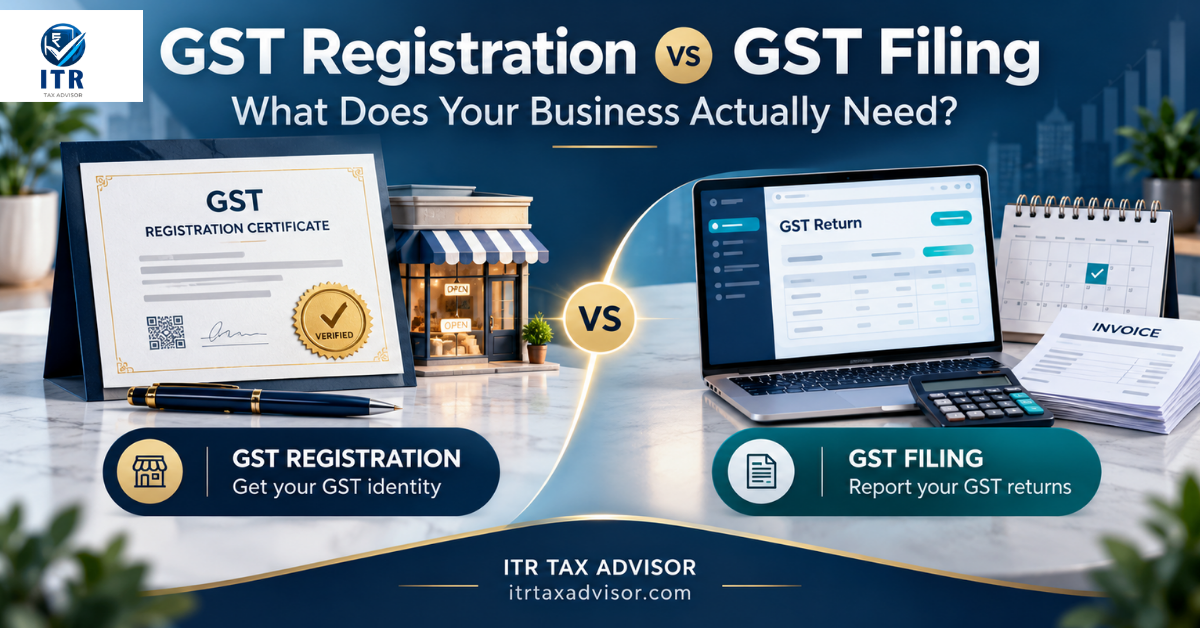
GST Registration vs GST Filing: What Does Your Business Actually Need?
Small business owners often use ‘GST registration’ and ‘GST filing’ as if they were the same thing. They are not. Registration is the one-time step that gives your business a tax identity — a GSTIN — while filing is the monthly or quarterly reporting that keeps that identity in good standing. Both are necessary, both are governed by the same law, and neither can be skipped once you cross the turnover threshold. This guide separates the two cleanly, shows which one you need right now, how much each costs, and how a chartered accountant typically prices each service in 2026.
What Is GST Registration?
GST registration is a one-time process that enrols your business with the Goods and Services Tax Network (GSTN) and issues you a 15-digit GSTIN. The GSTIN is PAN-based and state-specific — if you operate in two states you need two separate registrations against the same PAN. Registration is mandatory when turnover crosses Rs. 40 lakh for goods or Rs. 20 lakh for services, and from the first rupee for inter-state suppliers, e-commerce sellers and a handful of other notified categories. Once issued, the GSTIN stays with the business until you formally surrender it or it is cancelled by the department.
What Is GST Filing?
GST filing — also called return filing — is the ongoing monthly or quarterly report of your sales, purchases, input tax credit and tax payable. Regular registered taxpayers file GSTR-1 (outward supplies) by the 11th of the following month, GSTR-3B (summary and payment) by the 20th, and GSTR-9 (annual return) each year. Businesses under the QRMP scheme file GSTR-1 and GSTR-3B quarterly with monthly challan payments. Composition dealers file CMP-08 every quarter and GSTR-4 annually. Filing is where most of the recurring compliance load sits — and where most of the penalties come from if you miss a deadline.
Key Difference Between GST Registration and GST Filing
The simplest way to think about it: registration is one-and-done, filing is forever. Registration gives you a GSTIN; filing keeps you compliant. Registration costs nothing to the government and is a single application; filing is a monthly cadence that most small businesses outsource to a CA. Registration happens once in the life of the business; filing happens anywhere between 12 and 25 times a year depending on your scheme. Importantly, having a registration without filing is worse than having neither — you accumulate late fees, interest and ultimately risk cancellation. Our monthly GST Filing Charges India retainer covers both GSTR-1 and GSTR-3B on a flat-fee basis so your filings are never late.
Which One Does Your Business Need?
If you have never registered before and your business is new or just crossed the turnover threshold, you need registration first — filing comes later. If you already have a GSTIN but are behind on returns, you need filing (and possibly a late-fee clean-up). Most growing businesses need both at different points in their journey. We often see founders handle their GST Registration For Small Business themselves and only later realise that filing is a monthly discipline that benefits from a CA’s hand on the wheel.
How Much Does GST Registration vs Filing Cost?
Government fees are zero for both. Professional fees for a one-time GST registration typically range from Rs. 1,500 to Rs. 4,000 depending on entity type and documentation complexity. Monthly GST filing fees typically range from Rs. 500 to Rs. 2,500 per month per GSTIN depending on the number of invoices, number of states and whether you have export, SEZ or reverse-charge entries. Composition dealers pay less because they file only quarterly. A small trading business paying Rs. 1,000 per month for filing works out to about Rs. 12,000 a year — far less than a single late-fee event can cost.
Penalties for Not Filing GST Returns
Missing a GST return attracts a late fee of Rs. 50 per day (Rs. 20 per day for NIL returns) and interest of 18 per cent per annum on any tax due. A full GSTR-9 annual return default attracts Rs. 200 per day up to 0.5 per cent of turnover. More seriously, if you default on three consecutive GSTR-3B returns, the department can suspend your GSTIN and block you from issuing e-way bills — which effectively halts the business. A continuing default can lead to formal cancellation and the recovery of input tax credit already claimed.
Why Businesses Outsource GST Filing to a CA
The returns are not technically complex, but they are unforgiving. A single wrong HSN code, a missed invoice, an un-reconciled GSTR-2B or a wrong input credit claim can trigger a notice weeks or months later. A good CA keeps your sales and purchase registers reconciled with the portal, matches input credit against vendor filings, applies the right place-of-supply rules and files well before the deadline. The time you save is better spent running your business. ITR Tax Advisor’s CA-led filing team handles hundreds of monthly GST filings alongside Monthly Bookkeeping Services India so the sales register that feeds the return is already clean.
How to Simplify Your Entire GST Compliance
The cleanest approach is to treat registration and filing as parts of one compliance system, not two separate tasks. Set up registration with the correct principal and additional places of business, lock down your HSN or SAC codes, standardise your invoice format, maintain a daily sales and purchase register in your accounting software, and schedule the filing cadence. If you also use our broader Outsourced Accounting Services India service, your books, GST, TDS and MIS all run from one dataset — no reconciliations needed.
Get GST Registration and Filing Handled by ITR Tax Advisor
ITR Tax Advisor is a chartered-accountant-led practice that handles both one-time GST registration and ongoing monthly filing for businesses across India. Our team completes registration in three working days, files your GSTR-1 and GSTR-3B before every deadline, reconciles your input tax credit against GSTR-2B, raises invoices and e-way bills in your software, and sends you a short monthly compliance report so you know exactly where you stand. Reach out to our team at itrtaxadvisor.com for a quote tailored to your transaction volume.
How Technology Is Changing GST Compliance
The GST portal in 2026 is far more automated than it was in 2017. Pre-filled GSTR-1, auto-populated GSTR-3B, GSTR-2B input credit statements that match the vendor’s filing in near real time, and mandatory e-invoicing for businesses above the Rs. 5 crore turnover threshold have made compliance both easier and less forgiving. Easier because less data is typed manually; less forgiving because every mismatch is visible to the department instantly. A good filing partner uses this technology to your advantage, reconciling your books against GSTR-2B before every filing so you only claim credit that will not be reversed later.
Switching Between Composition and Regular Scheme
Many small businesses start under the composition scheme to keep compliance simple, then switch to regular when they begin selling inter-state or need to deal with GST-registered buyers who need input credit. The switch is bidirectional and happens at the start of a financial year — composition to regular via Form CMP-04, regular to composition via Form CMP-02. Timing the switch and recalculating input credit on existing stock is where a CA earns their fee; getting it wrong can cost you a year of input tax credit.
Frequently Asked Questions
Is GST registration the same as GST filing?
No. GST registration is a one-time process that gives you a GSTIN. GST filing is the recurring monthly or quarterly return you submit after registration. Registration enables you to do business; filing keeps that right alive.
Can I file GST returns without registration?
No. Only businesses holding an active GSTIN can file returns. If you need to collect or pay GST, you must register first.
What happens if I don’t file GST returns for a few months?
You accrue a late fee of Rs. 50 per day per return (Rs. 20 for NIL returns) plus 18 per cent interest on tax dues. Three consecutive defaults on GSTR-3B can lead to GSTIN suspension and e-way bill blocking, which effectively stops you from issuing taxable invoices.
Who should file GST returns — the business or a CA?
Legally, the business owner is responsible. Practically, most small and medium businesses outsource filing to a CA because the monthly reconciliation, input credit matching and portal work benefits from trained hands. The fee is modest relative to the cost of a single late-fee event.
How often do I need to file GST returns?
Regular taxpayers file monthly (GSTR-1 by the 11th, GSTR-3B by the 20th) plus an annual return. QRMP scheme taxpayers file quarterly with monthly tax payments. Composition dealers file quarterly CMP-08 and an annual GSTR-4.