
GST Registration for Small Business in India
CA-assisted, fully online, GSTIN without the headache
Starting or growing a small business in India almost always brings you to one question: do I need GST registration, and how do I get it right? Get it wrong and you risk penalties, blocked input tax credit, lost B2B clients, and rejected applications. Get it right and you unlock interstate sales, e-commerce platforms, tax credits, and the credibility that comes with a valid GSTIN. At ITR Tax Advisor, our Chartered Accountants handle your GST registration for small business end to end — online, accurately, and quickly — so you can focus on running your business.
With 25+ years in taxation and a team of CAs and company secretaries, we have registered businesses of every shape across India — proprietorships, partnerships, LLPs, and private limited companies. This page explains exactly when a small business needs to register, the benefits, the documents, the process, and why doing it through a qualified CA saves you time, money, and risk.
Need a GSTIN for your business?
Call 9406800066 • WhatsApp our CA team • Get a free quote
Free consultation — we will tell you if you need to register and what it costs.
What Is GST Registration?
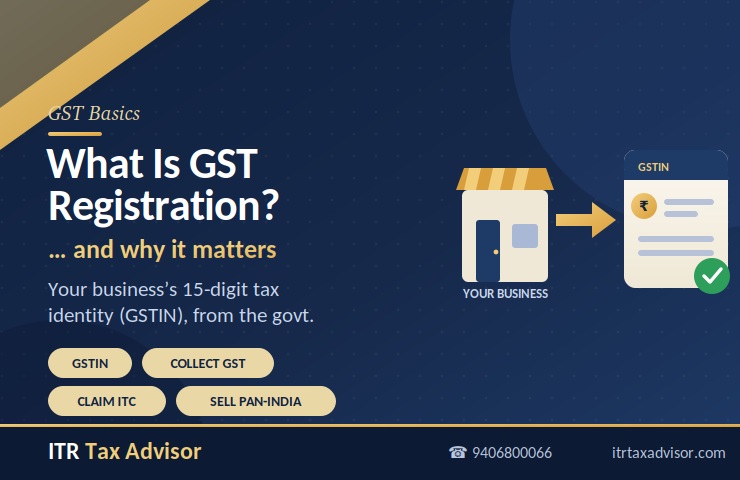
GST registration is the process by which a business obtains a unique 15-digit Goods and Services Tax Identification Number (GSTIN) from the government. Once registered, your business is legally recognised as a supplier of goods or services, can collect GST from customers, and can claim Input Tax Credit (ITC) on the GST it pays to its own suppliers.
Think of the GSTIN as your business’s tax identity. It appears on your invoices, lets you trade across state lines, and is increasingly demanded by corporate clients, marketplaces, and banks before they will do business with you. For a small business, registration is often the difference between staying a tiny local operation and being able to sell nationwide.
Who Needs GST Registration? Turnover Thresholds Explained
The small-business question answered clearly
Not every small business has to register, but many must — and many more benefit from doing so voluntarily. There are two ways you become liable: crossing the turnover threshold, or falling into a mandatory category regardless of turnover.
1. Turnover-based registration
You must register once your aggregate annual turnover crosses the prescribed limit. As a general structure:
- Businesses supplying goods — registration is generally required once turnover crosses ₹40 lakh in most states.
- Businesses supplying services — the threshold is generally ₹20 lakh in most states.
- Special category states — lower limits apply (commonly ₹20 lakh for goods and ₹10 lakh for services).
Because thresholds and state classifications can be revised, our CA confirms the exact limit that applies to your business type and state before you register — so you neither register too early nor miss a deadline.
2. Mandatory registration (regardless of turnover)
Some businesses must register from day one, even with low turnover, including:
- Anyone making inter-state supply of goods
- E-commerce sellers (selling through Amazon, Flipkart, etc.) and e-commerce operators
- Casual taxable persons and non-resident taxable persons
- Businesses liable to pay tax under the reverse charge mechanism
- Input service distributors and agents supplying on behalf of others
If any of these apply to you, registration is not optional — and filing late can attract penalties. This is exactly the kind of nuance where small business owners get caught out, and where expert guidance pays for itself.
Not sure if your small business needs to register?
Share your turnover and business type on WhatsApp — our CA will confirm the same day.
Call 9406800066 or request a free quote at itrtaxadvisor.com/contact-us
Benefits of GST Registration for Small Businesses
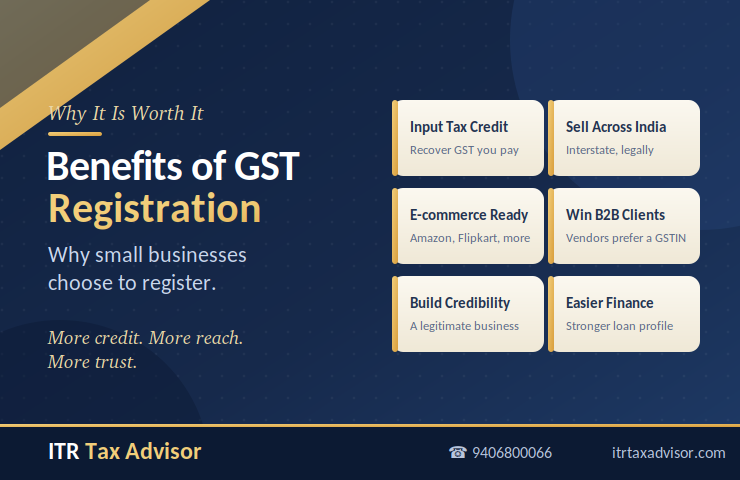
Even when registration is not strictly mandatory, many small businesses choose to register voluntarily because the advantages are significant:
- Claim Input Tax Credit (ITC) — recover the GST you pay on purchases, raw materials, and services, reducing your effective cost and improving margins.
- Sell across India — a GSTIN lets you make interstate sales legally, opening up customers far beyond your home state.
- List on e-commerce marketplaces — Amazon, Flipkart, and most platforms require a GSTIN before you can sell.
- Win B2B and corporate clients — larger companies prefer (and often require) GST-registered vendors so they can claim their own ITC.
- Build credibility — a valid GSTIN signals a legitimate, compliant business to customers, banks, and partners.
- Easier access to finance — registration and clean GST filings strengthen your profile for business loans and credit.
For a growing small business, these benefits usually far outweigh the modest compliance effort — especially when a CA manages the filings for you afterward.
Regular vs Composition Scheme: Which Suits a Small Business?
Small businesses often have a choice between the regular GST scheme and the composition scheme, and picking the right one materially affects your tax and paperwork.
| Feature | Regular Scheme | Composition Scheme |
| Best for | Growing businesses, B2B sellers | Small businesses with mostly local B2C sales |
| Tax rate | Standard GST rates | Low flat rate on turnover |
| Input Tax Credit | Can claim ITC | Cannot claim ITC |
| Interstate sales | Allowed | Not allowed |
| Filing | More frequent returns | Simpler, less frequent returns |
The composition scheme is attractive for very small, locally-focused businesses that want minimal paperwork and a low flat rate — but it forfeits ITC and interstate selling. The regular scheme suits businesses that buy inputs, sell B2B, or plan to grow. Our CA assesses your numbers and goals and recommends the scheme that genuinely costs you less and supports your plans.
Why Use a CA for GST Registration
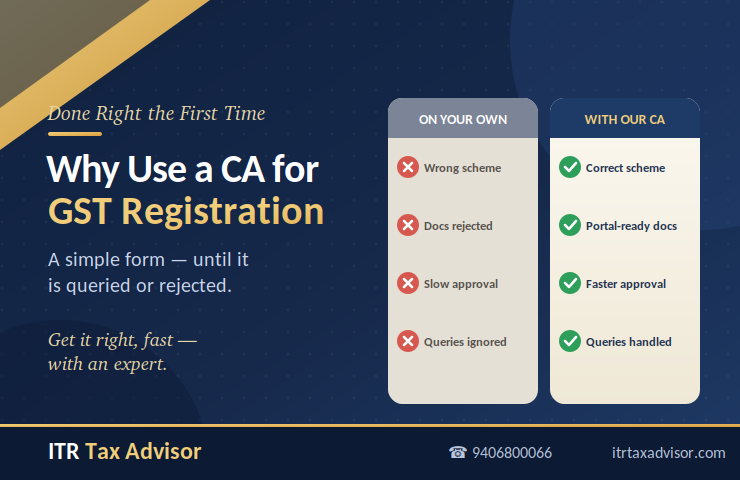
ca for gst registration — done right the first time
GST registration looks like a simple online form, and that is exactly why so many small businesses run into trouble. A single mismatched detail — a wrong business category, an unclear address proof, an incorrect HSN/SAC code, or a document that does not meet portal requirements — can get your application queried or rejected, costing you weeks. Using a CA changes that:
- Correct classification — we choose the right registration type, scheme, and codes for your business so you are not over- or under-registered.
- Clean documentation — we prepare and verify every document to portal standards, sharply reducing the chance of rejection or queries.
- Faster approval — a correctly filed application moves through verification with fewer hold-ups.
- Query handling — if the department raises a clarification, we respond on your behalf with the right supporting documents.
- Beyond registration — once you have your GSTIN, we can handle your ongoing GST return filing, so compliance never becomes a worry.
For a small business owner whose time is best spent on customers and growth, handing GST registration to a qualified CA is not an expense — it is leverage.
Want a CA to handle your GST registration end to end?
Call 9406800066 • WhatsApp us • Email info@itrtaxadvisor.com
Get your free quote: itrtaxadvisor.com/contact-us
Documents Required for GST Registration
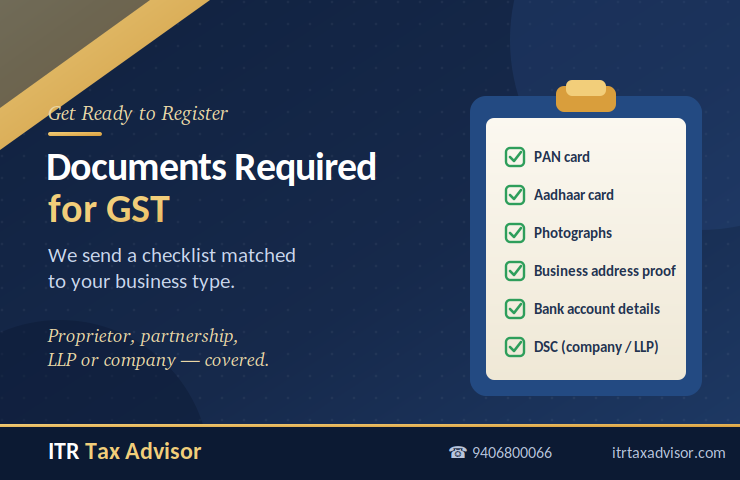
The exact list depends on your business structure (proprietorship, partnership, LLP, or company), but most small businesses need some combination of the following. We send you a tailored checklist so nothing is missed:
- PAN card of the business and/or the proprietor or partners
- Aadhaar card of the proprietor, partners, or directors
- Passport-size photographs
- Proof of business address — electricity bill, rent agreement, or NOC
- Bank account details — cancelled cheque or bank statement
- Business registration proof — partnership deed, incorporation certificate, etc. (where applicable)
- Digital Signature Certificate (DSC) for companies and LLPs
How GST Registration Works With ITR Tax Advisor
We have made the whole process remote and simple. Here is exactly what happens:
- Free consultation — call, WhatsApp, or submit the quote form. We confirm whether you need to register, which scheme suits you, and the cost.
- Share your documents securely — you send your documents digitally using our checklist; we review them for completeness and correctness.
- We file your application — your CA submits the GST application (REG-01) with the correct details and generates your Application Reference Number (ARN).
- Verification and queries — we track the application and respond to any departmental clarification on your behalf.
- GSTIN issued — you receive your GST registration certificate and 15-digit GSTIN, ready to use on invoices.
- Ongoing support — we can take over your GST return filing and year-round compliance, especially under our membership plan.
GST Registration by Business Type
Small businesses come in many legal forms, and the registration requirements differ slightly for each. Whatever structure you operate, our CAs handle it:
- Sole proprietorship — the most common small-business form. Registration is done under the proprietor’s PAN, with the owner’s Aadhaar, address proof, and bank details. This is the quickest structure to register and ideal for solo founders, freelancers, and local traders.
- Partnership firm — requires the firm’s PAN, the partnership deed, and the partners’ identity and address documents. We ensure the deed details match the application to avoid queries.
- LLP (Limited Liability Partnership) — needs the LLP’s incorporation documents, PAN, partners’ details, and a Digital Signature Certificate (DSC) for filing.
- Private limited company — requires the certificate of incorporation, company PAN, directors’ details, board resolution, and DSC. We coordinate the documentation so the application is right the first time.
- E-commerce sellers — whether you operate as a proprietor or a company, selling on marketplaces generally requires GST registration from the start. We get sellers registered fast so listings are not delayed.
If you are unsure which structure you fall under or are still setting up your business, we can advise on that too — and we also handle company and LLP registration if you need to incorporate first.
What Happens After GST Registration
Getting your GSTIN is the start of compliance, not the end of it — and this is where many small businesses stumble. Once registered, you take on a few ongoing responsibilities, all of which we can manage for you:
- Issue GST-compliant invoices — your invoices must carry your GSTIN, the correct tax breakup, and HSN/SAC codes. We help you set up a compliant invoice format from day one.
- File GST returns on time — registered businesses must file periodic returns even in months with no sales. Missing them triggers late fees regardless of turnover, so timely filing matters.
- Reconcile and claim Input Tax Credit — to actually benefit from ITC, your purchases must be correctly reported and reconciled. We handle the reconciliation so you do not lose credit.
- Stay amendment-ready — if your address, business details, or partners change, the registration must be updated. We file amendments quickly when needed.
With our membership plan, all of this becomes a non-issue: your returns are filed, your credits are claimed, and your compliance is monitored year-round, so you can run your business without watching the GST calendar.
Common GST Registration Mistakes Small Businesses Make
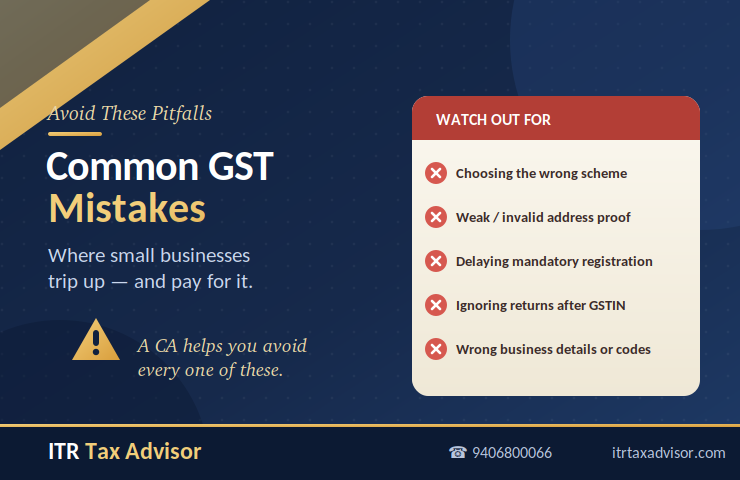
Self-filing small businesses repeatedly trip over the same issues. Knowing them is half the battle — and avoiding them entirely is why clients come to us:
- Registering under the wrong scheme — opting for composition when interstate sales or ITC matter, or vice versa.
- Weak address proof — documents that do not meet portal requirements, leading to rejection.
- Delaying mandatory registration — not realising that interstate or e-commerce activity requires registration from day one, then facing penalties.
- Ignoring returns after registration — registration is just the start; missed returns attract late fees even with zero sales.
- Wrong business details or codes — incorrect classification that causes problems later during filing or assessment.
Each of these is easily avoided with professional handling — and each can be expensive when it is not.
Why Choose ITR Tax Advisor for GST Registration for Small Business
Experience you can verify, service you can rely on
Thousands of businesses across India trust ITR Tax Advisor for GST and tax compliance. Here is why:
- 25+ years of taxation experience — deep expertise in GST and indirect tax across industries.
- Qualified CAs and company secretaries — your registration is handled by genuine professionals.
- Pan-India, fully online — register from anywhere in India without visiting an office.
- End-to-end GST support — registration, return filing, amendments, and advisory under one roof.
- Transparent, flat pricing — clear package rates with no hidden charges.
- Trusted by 600+ reviewers — with a strong record of satisfied small-business clients.
Our goal is simple: get your small business registered correctly, quickly, and stress-free — and keep you compliant long after.
Register your small business for GST with experts.
Call 9406800066 • WhatsApp our CA team • Email info@itrtaxadvisor.com
Free quote: itrtaxadvisor.com/contact-us • Ask about our membership plan for year-round compliance.
Frequently Asked Questions – GST Registration for Small Business in India
Is GST registration mandatory for a small business?
It depends on your turnover and activity. Registration is generally required once turnover crosses the threshold (broadly ₹40 lakh for goods or ₹20 lakh for services in most states), and is mandatory from day one for interstate suppliers, e-commerce sellers, and certain other categories regardless of turnover. Our CA confirms exactly what applies to you.
Can a CA handle my GST registration online?
Yes. Our entire GST registration service is online. You share your documents digitally, your CA files the application, handles any department queries, and you receive your GSTIN — without visiting any office.
What is the turnover limit for GST registration?
As a general structure, ₹40 lakh for businesses supplying goods and ₹20 lakh for services in most states, with lower limits in special category states. Because limits can change, we verify the current threshold for your business type and state before registering you.
What documents are needed for small business GST registration?
Typically PAN, Aadhaar, photographs, proof of business address, bank details, and business registration proof where applicable. Companies and LLPs also need a DSC. We provide a checklist tailored to your business structure.
How long does GST registration take?
A correctly filed application is usually processed within a few working days, subject to verification and any clarifications raised by the department. Filing it accurately the first time is the key to speed, which is where a CA helps.
What is a GSTIN?
GSTIN is your unique 15-digit Goods and Services Tax Identification Number issued on registration. It is your business’s tax identity and appears on all your GST invoices.
Should my small business choose the composition scheme?
The composition scheme offers a low flat rate and simpler filing, ideal for small, locally-focused businesses — but you cannot claim Input Tax Credit or make interstate sales under it. We assess your numbers and goals and recommend the right scheme.
What are the benefits of registering for GST voluntarily?
Voluntary registration lets you claim Input Tax Credit, sell across states and on e-commerce platforms, win B2B clients, and build credibility — often worth far more than the compliance effort for a growing business.
Do I need GST registration to sell on Amazon or Flipkart?
Yes. E-commerce sellers are generally required to have GST registration regardless of turnover. We can get you registered quickly so you can start listing.
What happens if I do not register when required?
Operating without registration when you are liable can lead to penalties and interest, and you lose the ability to claim Input Tax Credit. If you have crossed the threshold or fall into a mandatory category, it is best to register promptly.
How much does GST registration cost?
We charge transparent, flat package rates that depend on your business structure and whether you also want ongoing return filing. Contact us for a free quote tailored to your case.
Can you also file my GST returns after registration?
Yes. Registration is just the beginning. We handle your ongoing GST return filing and compliance so you never miss a deadline — ideal under our membership plan.
Is GST registration different for a proprietorship vs a company?
The core process is the same, but the documents differ. A proprietorship registers under the owner’s PAN, while companies and LLPs need their incorporation documents and a DSC. We handle every structure.
Can I register for GST from any state in India?
Yes. Our service is pan-India and fully online, so we can register your business no matter where in India you are based.
Why choose a CA over a do-it-yourself GST portal?
A CA ensures correct classification and scheme selection, prepares documents to portal standards, reduces the risk of rejection, handles queries, and supports your filings afterward. For a small business owner, that means faster approval and zero compliance stress.
Get Your Small Business GST-Registered Today
Do not let GST compliance slow down your growth. Let experienced Chartered Accountants handle your GST registration for small business online, accurately, and fast — and keep you compliant long after. Whether you are a proprietor, a partnership, or a growing company, ITR Tax Advisor has done it thousands of times over 25+ years.
Start your GST registration now:
Call 9406800066 • WhatsApp our CA team • Email info@itrtaxadvisor.com
Request a free quote: itrtaxadvisor.com/contact-us