
Startup Company Registration in India by CA
Incorporate the right way — investor-ready and benefit-eligible
How you register your startup at the very beginning shapes everything that follows — your ability to raise funding, the tax benefits you can claim, your credibility with customers, and how easily you can scale. Choose the wrong structure or skip Startup India (DPIIT) recognition, and you can leave real money and opportunities on the table. At ITR Tax Advisor, our Chartered Accountants handle your complete startup company registration in India — incorporating the right entity and securing your startup recognition — so you launch investor-ready, compliant, and positioned to claim every benefit available.
With 25+ years of experience and a team of CAs and company secretaries, we have incorporated and advised companies of every kind across India. This page explains how to register a startup, which structure suits your goals, what Startup India recognition unlocks, the documents and process involved, and the compliance that follows — so you can build on a solid foundation from day one.
Ready to register your startup the right way?
Call 9406800066 • WhatsApp our CA team • Get a free quote at itrtaxadvisor.com/contact-us
Free consultation — we’ll map your structure and benefits before you spend a rupee.
What Is Startup Company Registration?
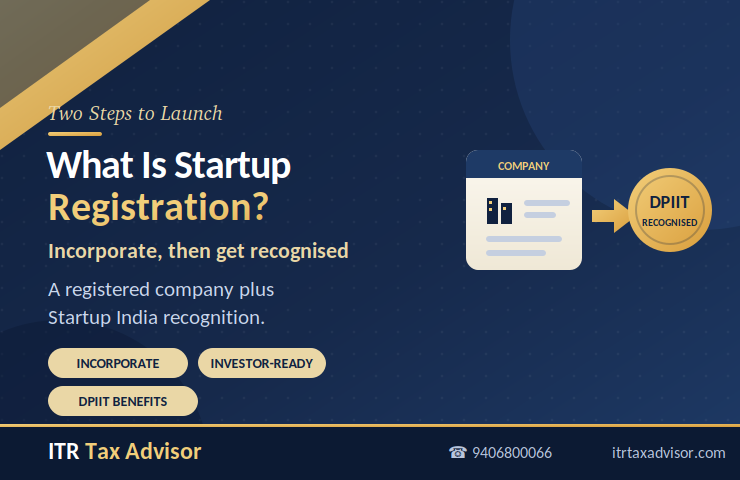
Startup Company Registration India is the process of legally incorporating your venture as a company (or LLP) with the Ministry of Corporate Affairs, and — where eligible — securing recognition as a startup under the Government of India’s Startup India initiative through the Department for Promotion of Industry and Internal Trade (DPIIT). The first step gives your business a legal identity; the second unlocks a package of startup-specific benefits.
It is important to understand that these are two distinct things. Incorporation makes your business a registered legal entity. DPIIT recognition is a separate status that an eligible incorporated startup can apply for to access tax exemptions, easier compliance, and other government support. A complete startup registration handles both — and that is exactly what we do for you.
Which Structure Should a Startup Choose?
Private Limited, LLP, or OPC?
The structure you incorporate under is one of the most important early decisions, because it affects your ability to raise funding, your compliance, and your tax. Here is how the common options compare for a startup:
| Factor | Private Limited | LLP | OPC |
| Best for | Funded, scalable startups | Services, low-capital | Solo founders |
| Raise equity / VC funding | Yes — preferred | Difficult | No |
| Issue ESOPs | Yes | No | Limited |
| Owners | 2 or more | 2 or more | 1 |
| Compliance | Higher | Moderate | Moderate |
For most startups that intend to raise external funding, issue ESOPs to employees, and scale, a Private Limited Company is the clear choice — it is the structure investors expect. An LLP can suit a bootstrapped services business that wants limited liability with lighter compliance, while an OPC fits a true solo founder. Our CAs recommend the right fit for your specific goals, and can later convert your structure as you grow.
Not sure which structure fits your startup?
Tell us your funding and growth plans on WhatsApp — our CA will recommend the right entity.
Call 9406800066 or request a free quote at itrtaxadvisor.com/contact-us
Benefits of Registering Your Startup
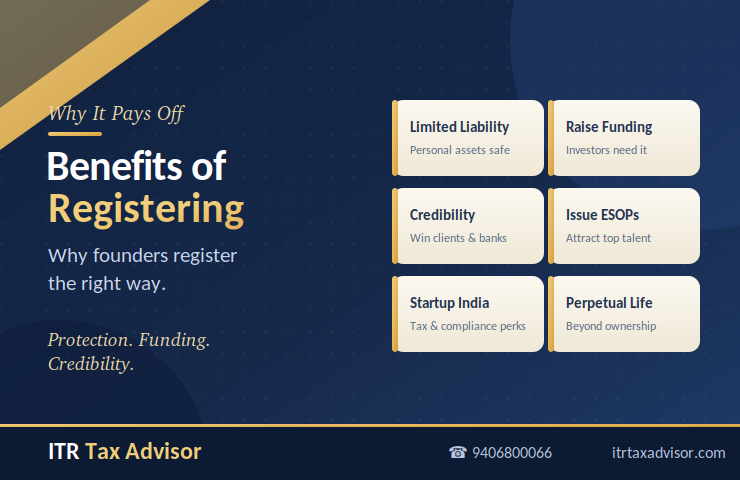
Registering your startup properly is not just a legal formality — it is what makes serious growth possible:
- Limited liability protection — your personal assets are shielded from business risks and debts.
- Ability to raise funding — investors and venture capital funds invest in registered companies, not unregistered ventures.
- Credibility and trust — a registered company wins more confidence from customers, partners, and banks.
- Issue ESOPs and bring in co-founders — share ownership to attract and retain talent.
- Access to Startup India benefits — once DPIIT-recognised, a range of tax and compliance benefits open up.
- Perpetual existence — the company continues independent of changes in ownership.
In short, registration turns an idea into a fundable, scalable business. The earlier you build on the right structure, the fewer expensive corrections you will face later.
Startup India (DPIIT) Recognition and Its Benefits
The benefits most founders miss
Beyond incorporation, eligible startups can apply for recognition under the Startup India initiative through DPIIT. This recognition is where some of the most valuable benefits live, and it is exactly the part many founders either do not know about or fail to claim correctly. Subject to eligibility and the conditions in force, DPIIT recognition can offer:
- Income tax exemption (Section 80-IAC) — eligible recognised startups can claim a tax holiday on profits for a set number of years within their early years, dramatically improving cash flow.
- Angel tax exemption (Section 56(2)(viib)) — relief on tax that would otherwise apply to investment received above fair value, important when raising early funding.
- Self-certification compliance — easier, self-certified compliance under certain labour and environment laws.
- Easier public procurement — relaxations that make it easier to participate in government tenders.
- Faster IPR processing — support and rebates for patent and trademark filings.
- Simplified exit — a faster process to wind down if a venture does not work out.
Eligibility conditions apply — including the entity type, the age of the startup, a turnover limit, and that the startup is working toward innovation or scalability and was not formed by splitting an existing business. Because these conditions and benefit limits are revised over time, our CAs confirm your eligibility and handle the recognition application correctly so you actually capture the benefits you qualify for.
Want your startup DPIIT-recognised and benefit-ready?
Call 9406800066 • WhatsApp us • Email info@itrtaxadvisor.com
Get your free quote: itrtaxadvisor.com/contact-us
Documents Required for Startup Registration
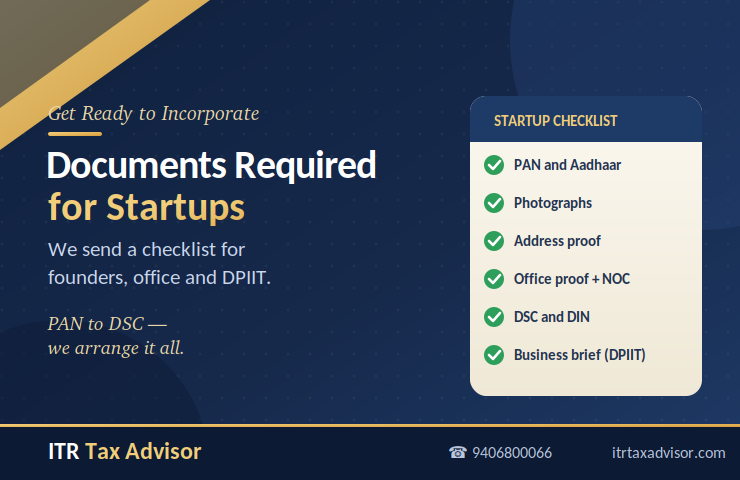
The exact list depends on your chosen structure, but most startup registrations need some combination of the following. We send you a tailored checklist so nothing is missed:
- For the founders / directors — PAN card, Aadhaar card, identity proof, address proof, and passport-size photographs.
- For the registered office — proof of the business address (such as a utility bill) and a No Objection Certificate from the owner if rented.
- For incorporation — Digital Signature Certificates (DSC) and Director Identification Numbers (DIN), which we help obtain.
- For DPIIT recognition — incorporation details and a brief on your business and how it is innovative or scalable.
Startup Registration Process With ITR Tax Advisor
We handle the entire journey online, from incorporation through recognition. Here is the step-by-step process:
- Free consultation — we understand your startup, recommend the right structure, and quote a transparent fee.
- Digital signatures and DIN — we obtain the DSCs and DINs needed for the directors.
- Name approval — we propose and reserve a unique company name with the Ministry of Corporate Affairs.
- Incorporation filing — we draft the MOA and AOA, file the SPICe+ application including PAN and TAN, and obtain your Certificate of Incorporation with CIN.
- DPIIT recognition — where eligible, we prepare and file your Startup India recognition application.
- Post-registration setup — guidance on bank account opening, GST registration, and the compliance calendar so you start clean.
Compliance After Startup Registration
Incorporation is the start of your company’s life, not the end of the paperwork. A registered startup has ongoing obligations, and missing them attracts penalties — so we can manage all of it for you:
- Annual ROC filings — annual returns and financial statements filed with the Registrar of Companies.
- Income tax return — the company files its own return each year, claiming any exemptions it is entitled to.
- Statutory records, meetings, and audit — maintaining registers, holding required meetings, and statutory audit as applicable.
- GST and TDS — registration and returns where they apply to your business.
- Funding-related compliance — filings and documentation when you raise investment or allot shares.
Because we also provide accounting, GST, tax, and ongoing advisory, your startup’s entire compliance can live with one trusted team — joined up, on time, and one less thing to worry about while you build.
Why Register Your Startup Through a CA
Startup registration involves entity selection, MCA filings, legal drafting, and a separate recognition process — and mistakes here are expensive to unwind later, especially once investors are involved. A Chartered Accountant changes that:
- Right structure from the start — we make sure you incorporate the entity that fits your funding and growth plans, avoiding a costly change later.
- Error-free incorporation — correct drafting and filing of all forms, reducing the risk of rejection and delay.
- DPIIT recognition handled — we secure the recognition that unlocks your tax and compliance benefits, done correctly.
- Investor-ready from day one — clean structure, documents, and compliance that stand up to investor due diligence.
- Ongoing partner — accounting, tax, and compliance handled as you grow and raise funds.
For founders whose time is best spent building product and traction, handing registration and compliance to a CA is leverage — and it protects the value you are creating.
When Should You Register Your Startup?
Timing matters more than many founders realise. Registering too late can cost you opportunities and benefits; registering thoughtfully at the right moment sets you up cleanly. As a guide, it is usually time to register when:
- You are ready to raise funding — investors need a registered company (typically Private Limited) before they can put money in, so register before fundraising conversations get serious.
- You are signing meaningful contracts — a registered entity gives you the legal standing and credibility to contract with larger clients and partners.
- You are bringing on co-founders or a team — formalising ownership and ESOPs early avoids painful disputes later.
- You want to limit personal liability — once real money and risk are involved, a registered company protects your personal assets.
- You want to claim startup benefits — DPIIT recognition and its tax benefits are only available to recognised, eligible startups, and the early years matter for the tax holiday.
In most cases, registering sooner rather than later is the safer choice — and our free consultation helps you decide the right moment and structure for your specific situation.
Common Mistakes Founders Make When Registering
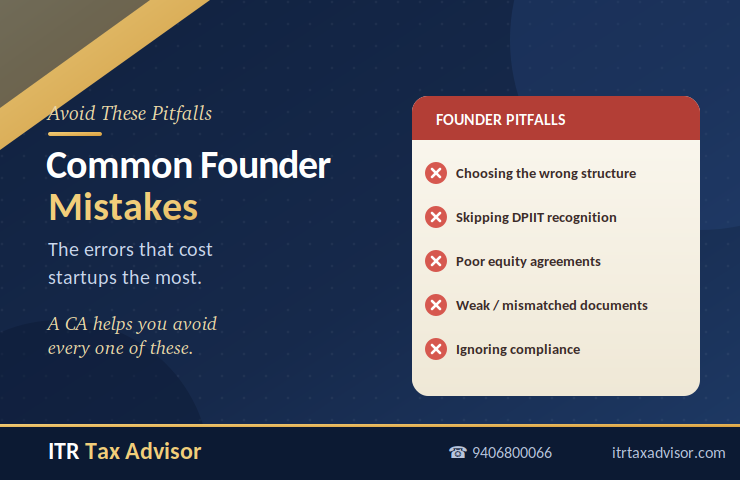
Founders who rush registration or do it without expert help tend to repeat the same costly errors. Knowing them is the first step to a clean start:
- Choosing the wrong structure — incorporating an entity that cannot easily raise funding or issue ESOPs, then having to restructure expensively later.
- Skipping DPIIT recognition — leaving valuable tax and compliance benefits unclaimed simply because they did not know to apply.
- Poor founder and equity agreements — unclear ownership and vesting that lead to disputes once the company grows or raises money.
- Weak or mismatched documents — KYC, address proof, or NOCs that do not meet MCA requirements, causing delays and rejections.
- Ignoring post-registration compliance — assuming the work ends at incorporation, then missing ROC and tax filings and incurring penalties.
Every one of these is avoidable with professional handling — and each is far cheaper to prevent than to fix once investors and growth are in the picture.
Why Choose ITR Tax Advisor
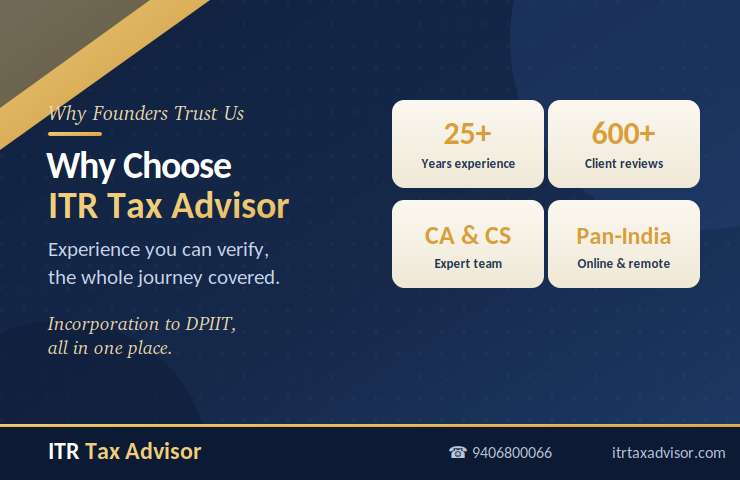
Experience you can verify, a partner for the whole journey
Founders across India trust ITR Tax Advisor to register and run their startups correctly. Here is why:
- 25+ years of experience — deep expertise in incorporation, startup recognition, tax, and compliance.
- Qualified CAs and company secretaries — your registration is handled by genuine professionals.
- Pan-India, fully online — register from anywhere in India without visiting an office.
- End-to-end support — incorporation, DPIIT recognition, GST, accounting, tax, and advisory under one roof.
- Transparent, flat pricing — clear package rates with no hidden charges.
- Trusted by 600+ reviewers — with a strong record among founders and businesses.
Our goal is simple: get your startup registered correctly, recognised where eligible, and compliant — so you can focus on building.
Register your startup with experts who’ve done it for 25+ years.
Call 9406800066 • WhatsApp our CA team • Email info@itrtaxadvisor.com
Free quote: itrtaxadvisor.com/contact-us • Ask about our membership plan for year-round compliance.
Frequently Asked Questions
What is startup company registration in India?
It is the process of incorporating your venture as a company or LLP with the Ministry of Corporate Affairs and, where eligible, obtaining Startup India recognition from DPIIT. Incorporation gives your business a legal identity; DPIIT recognition unlocks startup-specific tax and compliance benefits. A complete service handles both.
Which structure is best for a startup?
For startups that intend to raise funding, issue ESOPs, and scale, a Private Limited Company is usually best — it is the structure investors expect. An LLP can suit a bootstrapped services business, and an OPC fits a solo founder. We recommend the right entity for your specific goals.
What is DPIIT / Startup India recognition?
It is a recognition granted by the Department for Promotion of Industry and Internal Trade to eligible startups. It is separate from incorporation and unlocks benefits such as tax exemptions, easier compliance, and support for IPR and procurement, subject to eligibility and conditions in force.
What benefits does Startup India recognition offer?
Subject to eligibility, benefits can include an income tax holiday under Section 80-IAC, angel tax exemption under Section 56(2)(viib), self-certification on certain labour and environment laws, easier public procurement, faster IPR processing with rebates, and a simplified exit process. We confirm your eligibility and handle the application.
Can a CA register my startup online?
Yes. Our entire service is online. We obtain DSCs and DINs, reserve the name, file the incorporation, obtain your Certificate of Incorporation, and handle DPIIT recognition where eligible — with no office visit required.
What documents are needed to register a startup?
Typically PAN, Aadhaar, identity and address proof, and photographs for the founders; proof of the registered office with an NOC if rented; DSCs and DINs for the directors; and details of your business for DPIIT recognition. We provide a tailored checklist.
How long does startup registration take?
Incorporation is usually completed within a few working days once documents and name approval are in place. DPIIT recognition is a separate application. Filing everything accurately the first time is the key to speed, which is where a CA helps.
Is my startup eligible for DPIIT recognition?
Eligibility depends on the entity type, the age of the startup, a turnover limit, and that the startup is working toward innovation or scalability and was not formed by splitting an existing business. Because the conditions are revised over time, we confirm your current eligibility before applying.
Do I need a Private Limited Company to raise funding?
In practice, yes — equity investors and venture capital funds almost always invest in Private Limited Companies, which can issue shares and ESOPs cleanly. If raising funding is part of your plan, we will usually recommend incorporating as a Private Limited Company.
What is angel tax and how does recognition help?
Angel tax refers to tax that can apply on investment received by a company above its fair value. Eligible DPIIT-recognised startups can claim an exemption under Section 56(2)(viib), which matters when raising early funding. We ensure the conditions are met correctly.
What compliance does a registered startup have?
A registered company files annual returns and financial statements with the ROC, files its own income tax return, maintains statutory records, holds required meetings, and is subject to audit as applicable, plus GST and TDS where relevant. We can manage all of it.
How much does startup registration cost?
We charge transparent, flat package rates depending on your structure and whether you also want DPIIT recognition and ongoing compliance, including government fees. Contact us for a free quote tailored to your startup.
Can you also handle my startup’s accounting and tax?
Yes. Alongside registration we provide accounting, bookkeeping, GST, income tax, and advisory, so your startup’s entire compliance can sit with one joined-up team as you grow.
Can I convert my structure later as I grow?
Yes. Structures can be converted as your business evolves — for example, an OPC or LLP into a Private Limited Company when you prepare to raise funding. We handle conversions when the time is right.
Why register a startup through a CA instead of a DIY website?
A CA confirms the right structure for your funding plans, drafts and files everything correctly to reduce rejection risk, secures DPIIT recognition, and ensures you are investor-ready and compliant. For a founder, that means a faster, correct registration and a foundation that stands up to investor due diligence.
Register Your Startup the Right Way Today
Give your venture the foundation it deserves. Let experienced Chartered Accountants handle your complete Startup Company Registration India — the right structure, a clean incorporation, and Startup India recognition where eligible — so you launch investor-ready, benefit-eligible, and compliant from day one.
Start your startup registration now:
Call 9406800066 • WhatsApp our CA team • Email info@itrtaxadvisor.com
Request a free quote: itrtaxadvisor.com/contact-us