
What Is the Difference Between 12A and 80G Registration for NGOs?
If you run a trust, society or Section 8 company, two acronyms will come up repeatedly — 12A and 80G. Both are issued under the Income Tax Act, both are optional in theory, and both are nearly non-negotiable in practice once your NGO wants genuine tax savings and donor confidence. But they do very different jobs. 12A protects the NGO’s own income from tax; 80G rewards your donors for giving. Many founders assume they are two names for the same thing and apply late, lose years of exemption, or miss out on CSR funding. This guide clears up the difference, the eligibility criteria, the documents you will need, the process to apply in 2026, and when it makes sense to let a CA handle both together.
What Is 12A Registration?
Section 12A (now operating under Section 12AB after the 2020 amendment) is the registration that grants an NGO exemption from paying income tax on its surplus. Without it, every rupee of income the NGO earns — donations, grants, interest, programme income — is taxed as if the NGO were a regular business. With 12A, the surplus is tax-free as long as at least 85 per cent is applied to charitable or religious objects in the same year. Registration is granted by the Commissioner of Income Tax (Exemption) through Form 10A for the first provisional registration, and Form 10AB for permanent registration after three years.
What Is 80G Registration?
Section 80G is a benefit for your donors, not for the NGO itself. Once your organisation holds an 80G certificate, individuals and companies who donate to you can claim 50 per cent (or in a few cases 100 per cent) of their donation as a deduction from their taxable income. This single certificate makes a visible difference to fundraising — most Indian CSR teams and HNI donors will only consider contributing to an 80G-registered NGO because the deduction is a condition of their internal approval.
12A vs 80G — The Core Differences
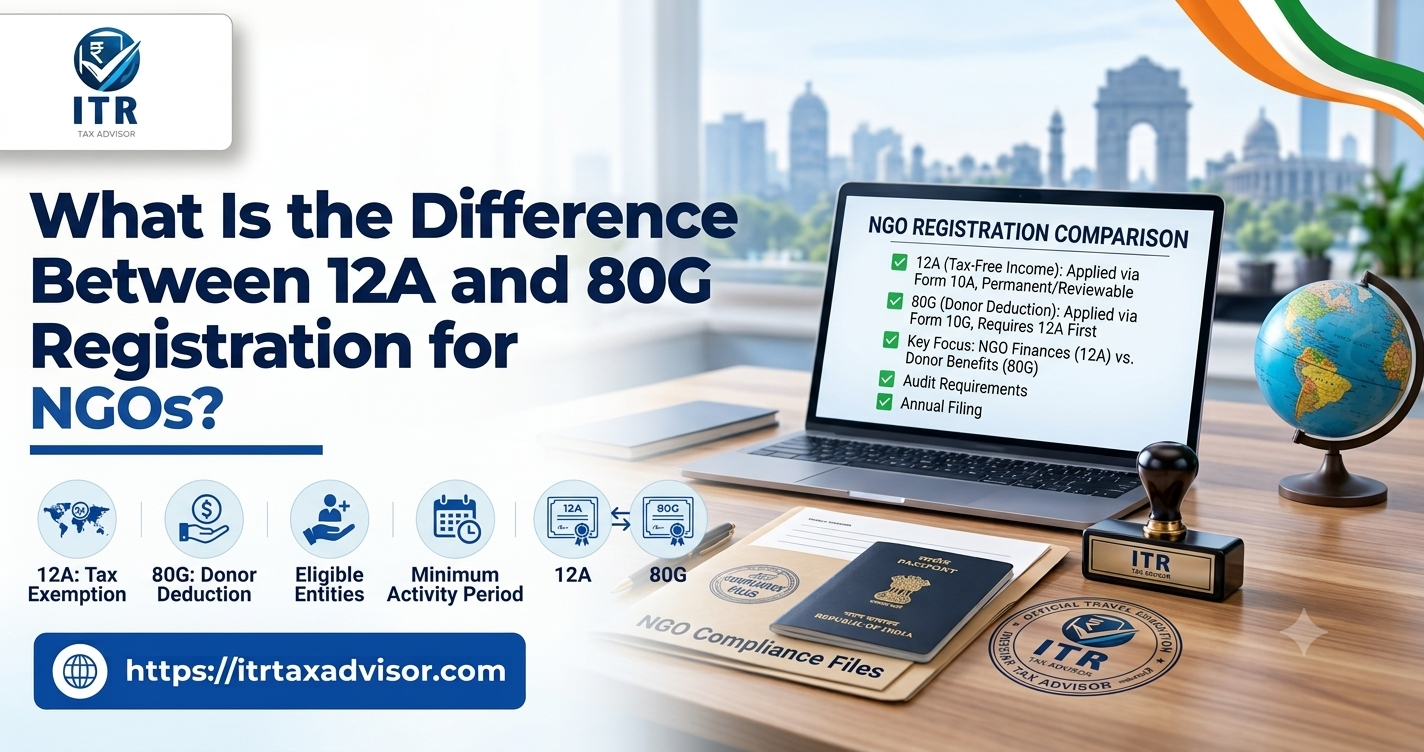
Both certificates come from the Income Tax Department but their beneficiaries are different. 12A exempts the NGO from paying income tax; 80G lets the donor claim a deduction. 12A is a prerequisite for 80G — you cannot apply for 80G without first holding valid 12A. 12A once granted remains valid as long as the NGO’s activities and objects do not change (now subject to five-year renewal under 12AB). 80G is granted alongside 12AB and runs on the same five-year renewal cycle. 12A alone makes an NGO tax-neutral; 80G makes it donor-attractive. Most well-run NGOs apply for both at the same time.
Who Is Eligible to Apply?
Any public charitable or religious trust, society registered under the Societies Registration Act, Section 8 company under the Companies Act 2013, or a non-profit established for genuine charitable purposes — education, medical relief, poverty alleviation, environment, yoga, preservation of monuments and so on — can apply for both 12A and 80G. The NGO must be legally registered, have a PAN in its own name, maintain proper books of accounts and, since 2021, must also complete Darpan registration on the NITI Aayog portal if it wishes to receive government grants. Private or family trusts set up to benefit specific individuals do not qualify. Our team that handles 12A Registration For Ngo does a quick eligibility review before filing to make sure your trust deed, objects clause and governing structure meet the Section 12AB tests.
Documents Required for 12A and 80G Registration
You will need the trust deed or society memorandum, PAN card of the NGO, Darpan ID (if applicable), bank account details, address proof, trustee/director PAN and Aadhaar copies, the latest three years’ financial statements (or a project report for a new NGO), details of all activities carried out so far, and a note explaining charitable objects and welfare work. For 80G specifically, you will also submit activity-wise expense statements. Our in-house CAs who handle 80G Registration For Ngo India prepare and review the full document pack before filing so your application does not come back with queries from the department.
How to Apply: Step-by-Step Process
Both 12A and 80G applications are now fully online on the income tax portal. Log in with the NGO’s PAN, open Form 10A (first-time or provisional) or Form 10AB (regular), fill in the objects clause, trustee details, bank information and attach every supporting document. New NGOs get a provisional registration valid for three years, after which you must apply for regular registration using Form 10AB at least six months before the provisional period ends. Approvals are typically issued within one to three months. Missing a renewal deadline can wipe out exemption retrospectively, so a calendar reminder is essential.
Benefits of Holding 12A and 80G Together
The combined effect is powerful. Your NGO pays no income tax on surplus, your donors claim a deduction, and your fundraising base widens overnight. 80G makes you eligible for CSR funding from Indian corporates (though technically a CSR-1 registration is also required). Grant-giving foundations in India and abroad use 12A and 80G as a basic trust signal — a kind of government stamp that your governance and books are in order. Banks also lend to NGOs more easily when both are in place. Our chartered-accountant-led NGO Tax Exemption India practice helps NGOs apply for both at the same time to save months of back-and-forth.
Common Mistakes to Avoid
Three mistakes come up again and again. First, applying for 80G without holding 12A — the application is rejected on day one. Second, letting the provisional period lapse before filing Form 10AB — this converts the NGO’s income into taxable income with retrospective effect. Third, drafting an objects clause too narrowly or too broadly, which forces the department to seek clarifications and delays approval. A careful review by a CA at the trust-deed stage avoids every one of these.
Partner With ITR Tax Advisor for 12A and 80G
ITR Tax Advisor is a chartered-accountant-led practice that has helped trusts, societies and Section 8 companies across India get both 12A and 80G registered without the usual delays. We prepare the document pack, draft any amendments the trust deed needs, file Form 10A or 10AB on your behalf, respond to departmental queries and hand you the certificates. If you also want help with Darpan registration, CSR-1 filing or your first year of accounts, we can handle those together. Write to our team at itrtaxadvisor.com to start your 12A and 80G journey.
Frequently Asked Questions
Can an NGO apply for 80G without having 12A?
No. 12A (now 12AB) is the mandatory prerequisite for 80G. The Income Tax Department will not process an 80G application unless the NGO is already registered under 12AB or has applied for both simultaneously.
How long does it take to get 12A and 80G registration?
Provisional registration is usually granted within one to three months of filing Form 10A, provided all documents are in order and no queries are raised. Regular five-year registration under Form 10AB may take two to four months.
Is 12A and 80G registration valid for a lifetime?
Earlier they were lifetime certificates. From April 2021, every NGO must renew both every five years, and new NGOs get a provisional registration first that is valid for three years. Renewal is through Form 10AB.
Can a Section 8 company get 12A and 80G registration?
Yes. Section 8 companies are explicitly eligible for both. The documents and process are the same as for a trust or society, with the Memorandum and Articles of Association used instead of the trust deed.
What is the tax benefit for donors under 80G?
Donors can claim a deduction of either 50 per cent or 100 per cent of the donated amount from their taxable income, subject to the 10-per-cent-of-gross-income cap for certain categories. The exact rate depends on how the NGO’s 80G is classified.