
How to Register for GST as a Small Business in India? Step-by-Step Guide
If you have just started a shop, a small manufacturing unit, a freelance practice or an online business, the Goods and Services Tax (GST) is one of the first compliance milestones you will meet. For some small businesses it is mandatory from day one; for others it kicks in only after you cross a turnover threshold. Either way, getting registered correctly matters — a wrong state code, a mismatched address or a missing director detail can block your GSTIN for weeks and freeze your invoicing. This guide walks you through every step of the 2026 GST registration process for small businesses, including documents, timelines, the composition scheme, and the common slip-ups that cost new founders time.
What Is GST and Who Needs to Register?
The Goods and Services Tax is India’s single indirect tax on the supply of goods and services, replacing VAT, service tax, excise and a dozen other state levies. Registration is mandatory if your aggregate turnover crosses Rs. 40 lakh for goods (Rs. 20 lakh for services, Rs. 10 lakh in special-category states), if you make inter-state supplies, if you sell through e-commerce platforms, if you supply through a reverse-charge mechanism, or if you fall under notified categories like casual taxable persons, agents and e-commerce operators. Even below the threshold, voluntary registration is often smart — it unlocks input tax credit, lets you deal with GST-registered customers and opens the door to GeM and larger procurement platforms.
Benefits of GST Registration for a Small Business
Registration gives you a 15-digit GSTIN that becomes your business’s tax identity. You can issue tax invoices, claim input tax credit on purchases, sell on marketplaces like Amazon, Flipkart and Meesho, apply for business loans with a clear tax trail, and work with corporate buyers who will not deal with unregistered vendors. A GSTIN also signals to customers that you are a serious operator — not an informal, cash-only player. Our chartered accountants who handle GST Registration For Small Business typically finish the full application within one working day of receiving documents.
Documents Required for GST Registration
The document set changes slightly by entity type, but the core list is the same. For a sole proprietor: PAN and Aadhaar of the proprietor, photograph, address proof of the business premises (electricity bill, rent agreement with NOC), bank account proof (cancelled cheque or statement) and a digital signature or Aadhaar OTP for verification. For a partnership or LLP: partnership deed, PAN of the firm, PAN and Aadhaar of all partners, authorised signatory letter, premises proof and bank proof. For a private limited company: certificate of incorporation, MOA and AOA, PAN of the company, board resolution authorising the signatory, PAN and Aadhaar of all directors, DSC of the authorised signatory, and premises and bank proof. Our One Person Company Registration clients and Startup Company Registration India clients often file for GST and incorporation in parallel to save time.
Step-by-Step: Apply for GST on the Portal
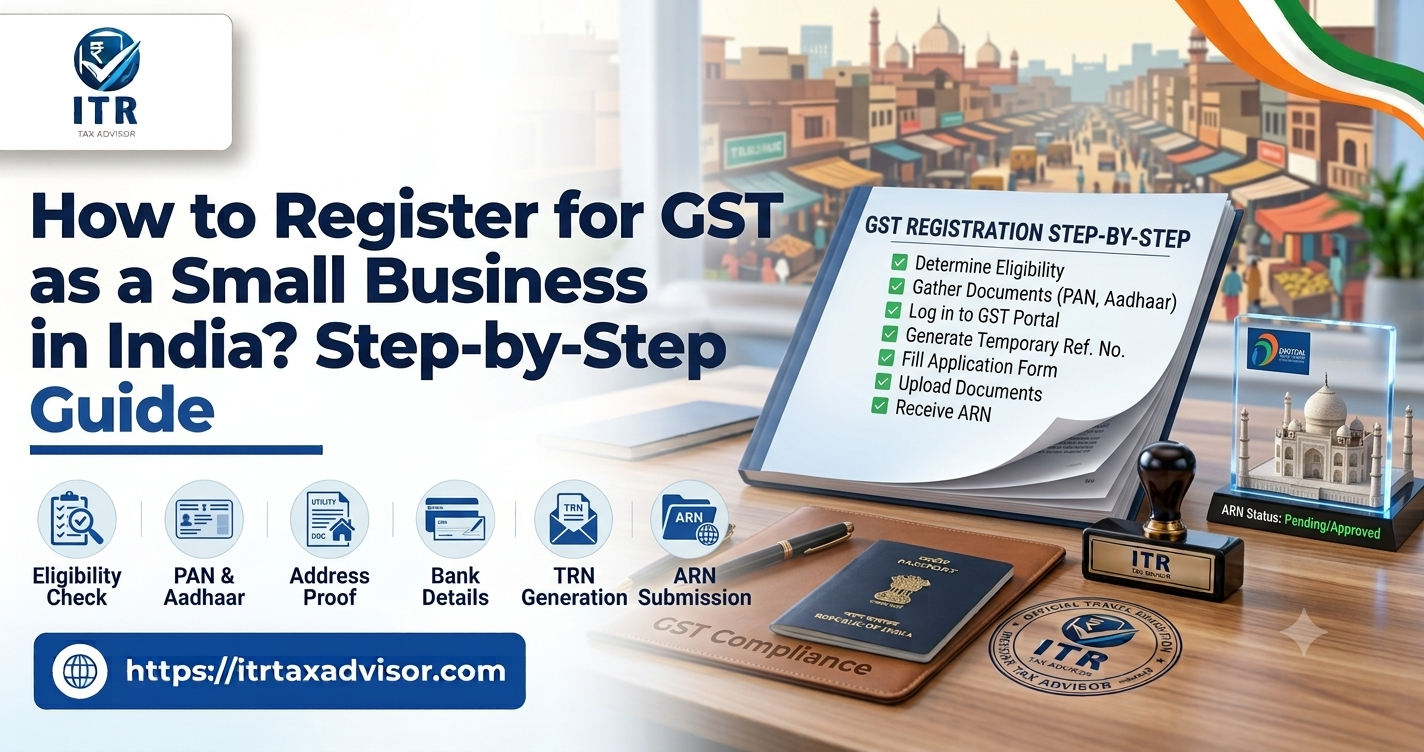
Visit gst.gov.in and click on ‘Register Now’ under the Taxpayers tab. Select ‘New Registration’, pick your state, enter your legal name as per PAN, email and mobile number — both will receive separate OTPs. The system then creates a Temporary Reference Number (TRN). Log in again with the TRN and continue with Part B: business details, promoter details, authorised signatory, principal place of business, additional places (if any), goods and services with HSN or SAC codes, and bank account. Upload every supporting document in PDF or JPEG under 1 MB each. Verify with DSC (mandatory for companies and LLPs) or EVC Aadhaar OTP, submit and note the Application Reference Number (ARN). The GSTIN is typically issued within three to seven working days unless the officer raises a query.
Composition Scheme — Should Small Businesses Opt In?
If your aggregate annual turnover is below Rs. 1.5 crore (Rs. 75 lakh in special-category states, Rs. 50 lakh for services), you can opt for the composition scheme. You pay a flat 1 per cent (traders), 2 per cent (manufacturers) or 5 per cent (restaurants, 6 per cent for other service providers under the special composition scheme) of turnover as GST, file a simple quarterly statement in CMP-08 and an annual return in GSTR-4. The trade-off is that you cannot collect GST from customers, cannot claim input tax credit and cannot sell inter-state. For a small local shop or restaurant, composition saves hours of monthly compliance; for a growing B2B business, regular registration is almost always better.
GST Registration Fees and Timelines
The government does not charge any fee for GST registration — only professional fees if you hire a CA to file for you. A clean straightforward application is usually approved within three to seven working days. If the officer raises a query under Rule 9, you have seven days to respond; failure to respond leads to rejection and you must restart. Aadhaar authentication during registration cuts the approval time to about one to three working days.
Common Mistakes to Avoid During GST Registration
The errors we see most often: mismatched name between PAN and application, incorrect state selection, missing NOC on rent agreements, poor-quality document scans, wrong HSN or SAC codes, choosing composition when the business plans to go inter-state, and forgetting to add the signatory’s authorisation letter. Any of these can trigger a Rule 9 notice and delay your GSTIN by weeks. A quick CA review before you hit submit catches almost all of them.
After Registration: Your First GST Compliance Calendar
Once you have your GSTIN, you must display it at every place of business, mention it on every tax invoice and start filing returns from the next tax period. Regular taxpayers file GSTR-1 (outward supplies) by the 11th and GSTR-3B (summary and payment) by the 20th of the following month. Composition dealers file CMP-08 quarterly and GSTR-4 annually. Our monthly GST Filing Charges India service handles both GSTR-1 and GSTR-3B for small businesses on a flat-fee retainer so you never miss a deadline.
Get GST Registered With ITR Tax Advisor
ITR Tax Advisor is a CA-led tax practice that registers small businesses, startups and professional firms for GST every day. We review your eligibility, pick the right scheme, prepare the document pack, file the application on the portal, handle any queries from the officer and hand you a working GSTIN — usually within three working days. We also set up your invoicing format, HSN codes and monthly filing calendar so you are compliant from the first invoice onward. Reach out to our team at itrtaxadvisor.com to get started.
Frequently Asked Questions
What is the GST registration turnover limit for small business in 2026?
The threshold is Rs. 40 lakh of aggregate annual turnover for suppliers of goods (Rs. 20 lakh in special-category states), and Rs. 20 lakh for suppliers of services (Rs. 10 lakh in special-category states). Inter-state suppliers, e-commerce sellers and reverse-charge persons must register from the first rupee.
Is GST registration mandatory for small businesses?
Mandatory only if you cross the turnover threshold, make inter-state supplies, sell through e-commerce platforms or fall under notified categories. Below the threshold, registration is voluntary — but very useful for input credit, marketplace selling and corporate contracts.
How long does GST registration take in India?
Three to seven working days for a clean application. Aadhaar-authenticated applications are typically processed in one to three working days. If a Rule 9 query is raised, add another week.
What are the fees for GST registration?
The government charges no fee for GST registration. You will only pay the professional fees of the CA or consultant who files on your behalf.
Can I register for GST voluntarily even if my turnover is low?
Yes. Voluntary registration is encouraged because it lets you claim input tax credit on purchases, deal with corporate and PSU buyers, sell on e-commerce platforms and build a verifiable tax history for loans. The compliance load is a monthly or quarterly return which a CA can handle on retainer.